Supported by the NY Consortium for Space Technology & Cornell University
The New York space and aerospace ecosystem contains roughly 400 private companies that collectively employ more than 70,000 New Yorkers. This network has current and historic connections to both NASA and the Department of Defense and is capable of even greater economic and cultural contributions in the years ahead. Yet, private companies in the New York space ecosystem face numerous challenges regarding employee recruitment and retention, financing, and access to quality testing and development resources. The network also suffers from a lack of attention from state-level elected officials and economic development policymakers.
This Needs Assessment was developed in partnership between Empire Space and the New York Consortium for Space Technology (NYCST). The goal of this project was to gain the first-ever hard data assessment of the current state of the private sector component of the New York space and aerospace ecosystem.
Empire Space was founded in 2022 as a 501(c)(3) non-profit to serve as the research and networking hub for the New York space ecosystem. The Empire Space Census is a publicly accessible database of the entire ecosystem, including private companies, academic institutions, non-profit and community organizations, and space-related facilities including planetariums, observatories, and key research complexes, such as the Brookhaven National Laboratory.
The New York Consortium for Space Technology (NYCST), led by Cornell University, is an agile, mission-driven collaboration that establishes a centrally located nexus for space-related education, infrastructure, expertise and capabilities aimed at catalyzing transformative growth in education, space technology, advanced manufacturing, and supply chain capabilities.
The partnership between NYCST and Empire Space is rooted in a common mission to better understand and grow the New York space ecosystem, particularly the private sector component that creates jobs. This Needs Assessment project is a fruition of that shared vision and first time there has ever been a sustained effort to gather concrete, stakeholder-informed data on the specific needs and underlying dynamics of the New York space ecosystem.
Empire Space collaborated with NYCST to create a Questionnaire that was used to identify sector needs. Considerations for the Questionnaire include selecting the mechanisms for feedback collection (e.g., survey tools), communications and distribution, and data processing (e.g., data aggregation and analysis tools), and then implementing these mechanisms. This also includes compiling contact information and methods for the Focus Group, and then the full NY space private sector contact set, in collaboration with NYCST.
The Questionnaire was the primary vehicle used to collect information and feedback for the Needs Assessment and benchmarking. Feedback was also collected from industry partners and NYCST members on the methods and content for the Questionnaire. This feedback was incorporated into the Questionnaire development in an iterative development process.
Empire Space solicited the Focus Group, sourced from NYCST and NYSG membership, and then the full NY space private sector contact set, using the Questionnaire and assessment mechanisms. This included sending the contact groups the Questionnaire and requesting responses. NYCST assisted with requesting responses to the Questionnaire.
For the Statewide Assessment, emphasis was placed on soliciting and receiving responses from a broad and comprehensive swath of New York State’s private space sector.
In addition to collecting data and feedback for the Needs Assessment and benchmarking, this solicitation was also used to iteratively refine and improve the Questionnaire and Needs Assessment methodologies via feedback mechanisms directly in the Questionnaire.
Respondents represented a broad cross-section of New York space companies, including by size, location, and duration of operations. The high degree of virtual work indicated by survey responses was higher than anticipated and could indicate a need to be more inclusive of these dynamics moving forward.
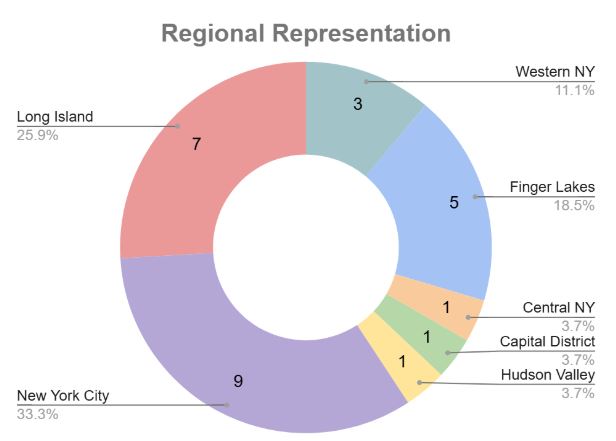
Graphic: Survey respondents represented most of the state, with more responses from companies in regions with larger space ecosystem clusters.
Respondents covered a broad range of companies, including Core Space firms, Aerospace companies, and Space & Defense companies.
Respondents broke down into roughly even thirds by financial status, with ⅓ self-reporting as ‘pre-revenue’, ⅓ reporting as ‘revenue generating’, and ⅓ reporting as ‘profitable’.
Respondents covered a very broad range of focus areas, with the largest groups being Space Force/Military, Aerospace Manufacturing, Satellite Manufacturing & Servicing, Earth Sensing, and Space Data.
Most respondents reported their primary buyers are commercial businesses, followed by military agencies of the US government.
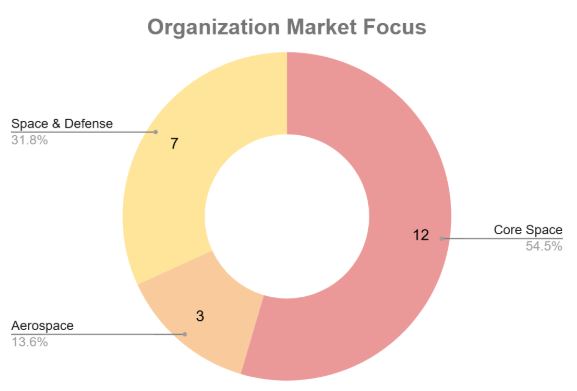
Graphic: Roughly ⅓ of respondents indicated a Space & Defense focus, with the remainder largely focused on Core Space, and a minority focused primarily on more terrestrial aerospace work.
Big Conclusion: More than ⅔ of New York space companies do at least some work with the US government and indicate sufficient opportunities exist, but many report struggles with internal capability to handle paperwork and comply with regulations.
Federal government contracts and activity plays at least some role for over ⅔ of New York space companies.
A majority of firms reported obstacles in contracting with the US government, but not an overwhelming majority. This indicates that there may be specific types of companies experiencing difficulties with government contracting, rather than the sector as a whole.
These obstacles manifest themselves in specific parts of the contracting process. Most companies report issues with a lack of internal resources and significant paperwork, rather than a lack of opportunities. This suggests a need to increase internal supports and resources so New York space companies can more readily take advantage of the opportunities in front of them.
Most companies report a Moderate level of difficulty complying with State & Federal regulations. This indicates that work must be done assisting companies navigate the regulatory environment, but most companies do not view it as a major impediment to their operations.
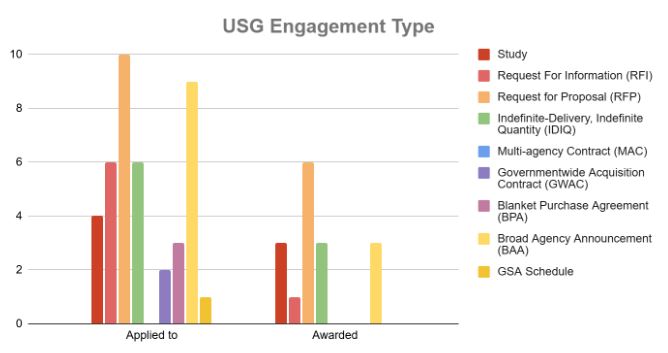
Graphic: New York space companies have a wide range of engagement types with the U.S. government. A majority of the work has been in the area of Studies, RFPs, and RFIs, but companies also had numerous other types of engagement vehicles.
Big Conclusion: Government & Venture Capital funding sources are the preference of New York space companies, but report barriers with attaining access to them.
Companies unsurprisingly indicate interest in a wide range of funding sources, but with some interesting trends. Government Grants or Awards are indicated to be both the highest priority target and the source companies face the greatest difficulty in attaining. The second more prominent funding source is Venture Capital, with a similar trend in related difficulty in attaining. This indicates that it should be a priority to reduce barriers to government funding sources, perhaps by increasing state-level sources to complement federal ones. This also indicates a need to deepen connectivity between New York space companies and financial institutions in NYC
Companies indicate that despite the strong interest in securing government sources of funding, most have been unable to do so at either the state or federal level. It is clear that more must be done to connect New York space companies to the government funding sources they are seeking.
NY space companies reported using a cohort of state-based government programs for their operations. The NASA NY Space Grant (which is funded federally but administered at the state level), AFRL Regional Hub, and Department of Economic Development all provided support to respondents.
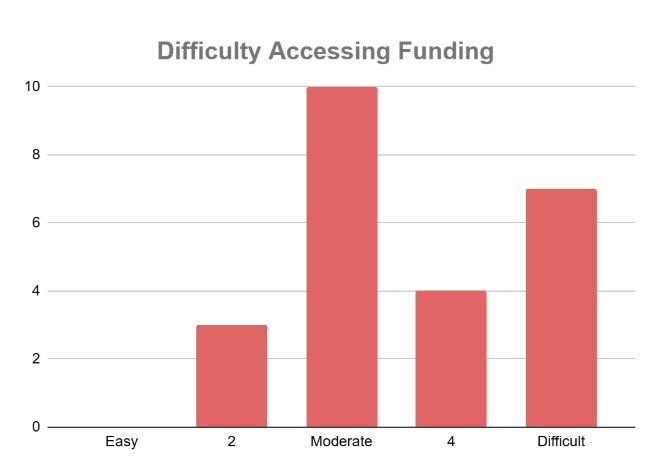
Graphic: Most companies report that it is anywhere from ‘Moderate’ to ‘Difficult’ for them to access sufficient funding for their operations. This affirms our existing belief and experience that most New York space companies face funding difficulties.
Big Conclusion: There is strong systemic interest in greater access to a broad range of testing capabilities, particularly vibration testing, thermal vacuum testing, radio frequency testing, and shock testing. More must be done to support New York space companies that require access to launch capabilities.
Companies reported a wide range of specific testing limitations, all of which will require novel solutions to resolve. Cost, accessibility, and availability of testing were all widely mentioned as major barriers for companies.
Companies reported interest in most testing options offered in the survey, indicating a desire for a broad range of capabilities. Vibration testing, thermal vacuum testing, radio frequency testing, and shock testing were the most commonly cited capabilities companies would like greater access to. Acoustic testing, thrust chamber testing, and rocket and launch pad testing were also listed as desired capabilities.
Most companies that require access to launch report modest to severe difficulty with procuring the access they need. Because these services cannot be obtained in New York, special focus must be made on how best to facilitate the external connections necessary for New York companies that need launch services to obtain them.
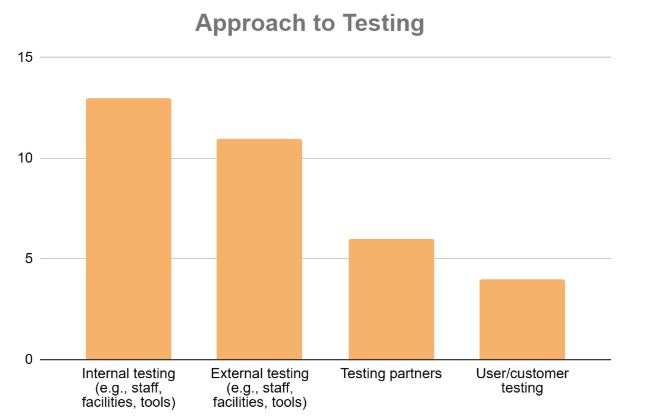
Graphic: Respondents utilized a range of methods to address their testing needs. The most common response was ‘Internal’, but this was only a plurality of respondents. The majority either utilized external testing capabilities or some form of partnership.
Big Conclusion: Companies prefer to upskill existing employees, and struggle to find employees with appropriate technical and domain-specific expertise.
The greatest number of companies anticipate needs in Production & Manufacturing, Research & Development, and Testing in the future.
Companies report the greatest challenges in the Quantity and Quality of Applicants, as well as the overall Cost of Staffing. Despite these challenges, most New York space companies report positive job growth over the last year, indicating an underlying resiliency and strong fundamentals in New York’s space economy.
Companies indicated a very high priority on upskilling their existing employees, with most companies using in-house means to fulfill this need. It does appear that online training, conferences, and academic support would have some benefit to some companies, many respondents indicated the ability and/or desire to keep this process internal.
The vast majority of respondents reported hiring difficulties in areas such as Technical Training, Project-specific skills, and Domain Understanding/Experience. Very few companies reported issues with hiring based on degree type, education, or enthusiasm. This confirms anecdotal insights from Empire Space and confirms an industry need for flexible, technical programming instead of more traditional degree programs.
The greatest number of companies anticipate needs in Production & Manufacturing, Research & Development, and Testing in the future.
Most companies report at least Modest difficulty with acquiring Technicians and Trade/Associates-level talent. This indicates a need to build out this level of technical-based programming from the academic sector.
Companies report the greatest challenges in the Quantity and Quality of Applicants, as well as the overall Cost of Staffing. There were far fewer reports of issues with staff retention or the hiring process overall. This indicates that many challenges facing companies lie with the pool of applicants available in society, and less internal barriers at a managerial or corporate level.
A majority of respondents anticipated challenges scaling their operations in the future, although it was not universal. Alleviating these barriers to development is perhaps the single most important task for the New York space ecosystem, ensuring companies can grow their operations here in New York. These scalability challenges exist in numerous dimensions for New York space companies, but production, technical capabilities, and regulatory compliance are the greatest anticipated challenge areas.
Despite these challenges, a majority of respondents report positive job growth within the last year. This indicates a resiliency and foundational potential in New York space companies, that are still managing to grow despite numerous challenges. Companies also largely indicated they intended to grow this year, again highlighting positive momentum for New York space companies.
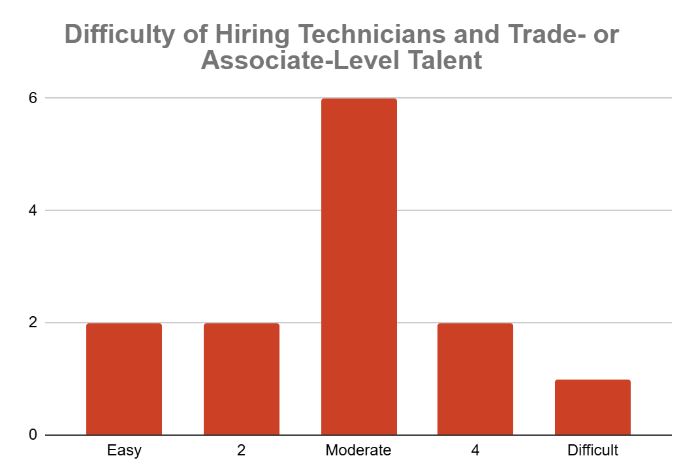
Graphic: Most companies report at least Modest difficulty with acquiring Technicians and Trade/Associates-level talent. This indicates a need to build out this level of technical-based programming from the academic sector.
Big Conclusion: New York space companies are unhappy with their generally low level of connectivity with other parts of the space ecosystem, and are focused on deeper industry and legislative connections. While currently externally focused, space companies are very interested in attending future networking events and are generally optimistic about the 5 year future of the New York space ecosystem.
Companies reported generally quite low levels of connectivity with other components of the New York space ecosystem. ‘Never’ and ‘Once or Twice a Year’ were the most common responses regarding connectivity with Nonprofits, Academic Groups, and other Space Companies. The group with the highest relative connectivity appears to be other space companies, likely through supply networks, trade conferences, organization affiliations, etc…
Roughly half of companies report that the majority of their connections were out-of-state, with another roughly 25% reporting a mix between in-state and out-of-state. Only 25% of New York space companies report their greatest concentration of connections as mostly within New York. This confirms long-standing conclusions from Empire Space that most companies have a largely external focus, indicating a need to foster greater local and statewide connectivity for New York space companies.
Respondents were generally not positive about their level of connectivity within the state. This indicates a need for greater programming and networking opportunities that appeal to companies and their growth objectives.
Companies expressed clear preferences regarding what connections they believe would be beneficial to have more of. Internal Industry connections with partners and suppliers, Legislative connections, Across Industries, Media, Finance, and Talent/Academic. There was relatively low priority put on Civic, Community, and Administrative groups. There is modest belief among some respondents that Industry and Talent connections are currently working well, but there is low belief that any other type of connection is currently working well.
Companies report very low levels of connection with Elected Officials at any level of government. None had connections at any level on a Weekly or Daily basis, and more than half reported no connection with any level of government at any level. Roughly half of responding companies would have some legislative engagement on a monthly or annual basis, with Federal connections more likely than State or Local connections. Combined with the previously indicated belief companies have that legislative connections would be beneficial, this is clearly a high priority area of focus for New York’s space company network.
Companies report a significant likelihood of engaging in future events, with ‘Highly Likely’ the response of well over half of participants. This confirms an eagerness among a large majority of space companies for greater networking and connectivity opportunities here in New York.
Companies express significant optimism about the future of the New York space ecosystem over the next 5 years. ‘Very Optimistic’ is the most common response, Almost 90% of companies are at least ‘Somewhat Optimistic’, indicating the positivity is widespread among companies of virtually all types, in all regions.
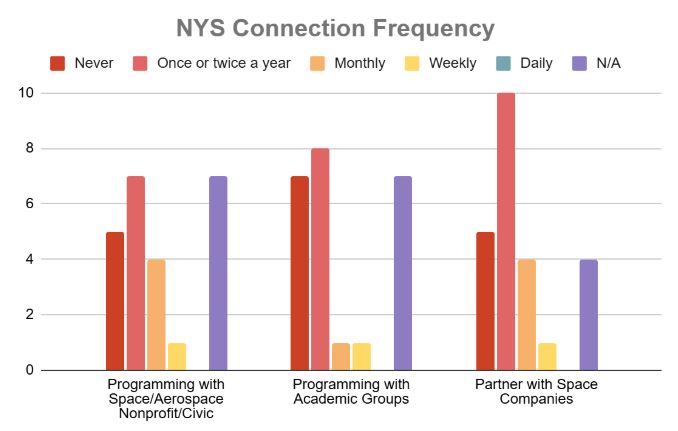
Graphic: Companies reported generally quite low levels of connectivity with other components of the New York space ecosystem. ‘Never’ and ‘Once or Twice a Year’ were the most common responses regarding connectivity with Nonprofits, Academic Groups, and other Space Companies. The group with the highest relative connectivity appears to be other space companies, likely through supply networks, trade conferences, and organization affiliations.
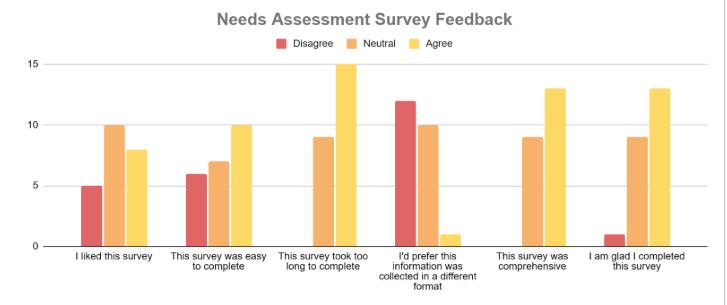
Respondents were generally satisfied that they completed the survey, found it comprehensive, and agreed it took too long to complete. This indicates a need for greater concision in some lines of questioning to make the survey more efficient and reduce completion times.
Empire Space and NYCST will adopt a series of strategies and responses to the identified challenges that will fit into a few broad categories.
Programming & Networking: Hold new virtual and in-person events that fill gaps across the state. Example: hold job fairs to connect graduates with open jobs in space and aerospace companies, or mixers that allow companies and financial institutions to mingle.
Information & Publicity: Conduct outreach and educational campaigns among the general public and the space ecosystem as a whole.
State-level Outreach: Provide targeted engagement with important state-level entities including economic development organizations like Empire State Development and members of the New York State Legislature.
Capacity Building: Bring new facilities and resources online that enhance opportunities available to private sector companies. One example is the new satellite testing and development facilities NYCST is building at Cornell University.
Empire Space has developed the following solutions and interventions as a way to turn the insights gathered from this survey into action, providing concrete pathways to growth for New York’s space companies.
Government Relations Interventions:
> Develop a ‘clearinghouse’ hub for companies to use that provides advice, guidance, and surplus capacity regarding government contracting assistance and regulatory compliance.
> Encourage companies to develop legislative outreach tools at the State and Federal level so legislators and the government agencies they oversee can be more aware of and responsive to these government relationship concerns.
> Hold an annual Space & Aerospace Day at the NYS Capital in Albany during the Legislative Session so State Lawmakers can interact with the entire spectrum of the industry and spend at least one day primarily focused on their opportunities and concerns.
Financing & Funding Interventions:
> Provide centralized databases of available government and venture capital funding opportunities for New York space companies.
> Increase networking between space companies and both legislators and venture capitalists to better understand the dynamics and access opportunities of both funding sources.
Research & Testing Interventions:
> Identify existing in-state testing resources and better connect them to space companies who need those resources.
> Partner with key academic and governmental institutions and facilities that are developing new resources (such as NYCST) to bring new capabilities online as soon as is practical.
> Establish dialogue with key state-level agencies and policymakers to promote the research of testing needs of New York space companies in appropriate development frameworks.
Hiring & Staffing Interventions:
> Facilitate formal dialogue between New York space companies and the leaders of the SUNY and CUNY systems to transmit these priorities to them so they can then develop programming that is better aligned with these needs.
> Create a database of existing academic programs that fill these needs and ensure they are properly networked to the job opportunities at New York space companies.
> Develop connections with state-level policymakers to assist companies in taking advantage of existing programs and services while laying the groundwork for new investments and programs.
Ecosystem Connectivity Interventions:
> Increase the frequency and diversity of networking and collaboration opportunities both within space companies and between space companies and other sectors of the space ecosystem.
> Create sector-specific Working Groups that focus on increasing connectivity for key areas (Optics, satellite data, AI, defense, etc…)
> Empire Space will work with NYCST and stakeholders across New York to implement these interventions in a timely and comprehensive fashion. Bringing these interventions into reality will make substantive progress in addressing the challenges that New York space companies identified and lay the groundwork for greater economic growth and development in New York’s space economy in the years ahead.
Benchmarking is a critically important exercise that is a logical extension of the Needs Assessment project. In order for the New York space ecosystem to properly grow and become a major player in the 21st century American space economy, it is imperative to measure the health and dynamism of the sector in a comprehensive manner that allows holistic understanding, as well as targeted and proactive investment in the ecosystem’s health and vitality.
The complete Needs Assessment project will result in a comprehensive dataset on the health, vitality, and challenges of the private sector component of the New York space ecosystem.
With the lessons learned from this process, Empire Space and NYCST will begin an annual survey process that will enable a number of important developments:
> Gathering initial data and establishing a relationship with any new businesses that have opened in New York since the last survey.
> Establishing trendline data for the New York space ecosystem for the first time, measuring changes in critical areas over time. This will enable much more effective and timely responses to developing challenges.
> Building an increasingly detailed and comprehensive data set of the ecosystem, enabling more informed outreach and educational efforts targeted at economic development agencies and elected officials.
> Establishing baseline metrics for employment, revenue generation, government relations, economic awards, and other key criteria established by Empire Space and NYCST. Future growth and development will be measured against these baselines to properly analyze the underlying ecosystem dynamics.
This Needs Assessment was the first such project Empire Space has undertaken, but it will not be the last. This data is transformative for New York’s space economy, offering insights and detailed stakeholder feedback that has never existed before.
There are a number of steps that Empire Space will take implementing the recommendations of this report and ensuring the interventions identified are applied to resolve the barriers holding back growth for New York’s space companies.
Empire Space will use this model and the feedback gathered to refine our survey methodologies and identify additional stakeholder groups in the New York space ecosystem to survey. This includes future surveys of the private companies included in this survey.
Empire Space and NYCST will incorporate this data into their long-term joint planning in a systemic and comprehensive way. The identified interventions will be tracked for progress and metrics will be established to ensure the survey data and conclusions highlighted in this report becomes a living document that actively contributes to economic growth in the New York space ecosystem.
The following implementation actions will be taken to ensure long-term compliance with the recommendations in this report:
Inclusion of status updates during monthly Empire Space/NYCST strategy meetings to track progress on action items.
Creation of a concise list of the listed interventions into a separate tracking report that Empire Space will maintain to track progress on the identified solutions.
Additional Ecosystem Surveys
Empire Space will be conducting additional surveys in the model of this Needs Assessment in other sectors of the New York space ecosystem. These surveys will include the following target groups:
> Academic organizations including colleges and universities, as well as K-12 institutions with ties to space related programming.
> Non-profit and informal education actors such as museums, planetariums, observatories, community astronomy clubs, and STEM organizations.
> The space finance sector, including venture capital firms, startup accelerators, and established large banks and financial institutions with ties to the space sector.
> Women- and Minority-led private sector companies and academic organizations that serve historically underrepresented groups, to understand the specific barriers facing these stakeholders and how to overcome them.
Empire Space will establish an annual/bi-annual survey pattern for New York’s private space companies to establish trendlines and better refine our understanding of their challenges and opportunities.
The Needs Assessment project being conducted by Empire Space and NYCST will offer unprecedented detail into the dynamics, challenges, and opportunities among the private sector companies of the New York space ecosystem. This data is critical to developing the programs and capabilities to unlock a new era of growth and development for New York space companies.
This growth will enhance New York’s contribution to the nationwide space economy, including numerous applications to the Department of Defense and America’s military readiness in space. Empire Space is honored to conduct this project and advance these important initiatives for the New York space ecosystem today and for many years to come.