This report presents a preliminary overview of open job postings across New York State's space and aerospace sector, based on a survey of 321 companies with a known presence in New York state, conducted in February and March 2026. The goal of this report was straightforward: establish a baseline count of active hiring activity, understand where jobs are concentrated geographically, and identify patterns in how companies are hiring throughout New York.
Across the 321 companies surveyed, Empire Space identified 1,604 open positions. That number likely understates true demand—191 of the 321 companies either had no active postings or no careers page at the time of review, meaning a substantial portion of hiring activity is not publicly visible at any given moment.
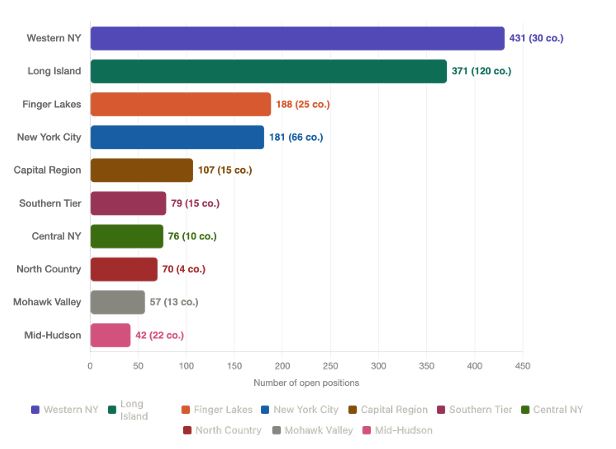
A few findings stand out. First, hiring is heavily concentrated: just 34 companies with 10 or more open positions account for roughly 76% of all jobs identified. Second, the sector is geographically distributed across all ten New York State regions, with Western New York (431 positions) now leading the state, followed closely by Long Island (371 positions). Third, most roles require physical presence (only a small share of positions are fully remote), reflecting the hardware-intensive nature of the industry. Finally, at least 42% of identified positions are at companies that explicitly require U.S. citizenship or security clearance eligibility, a meaningful structural constraint on who can access these jobs.
Total companies surveyed: 321
Companies with active job postings: 130 (40.5%)
Total open positions identified: 1,604
Top hiring region: Western NY, (431 positions, 30 companies)
Largest single employer: Moog Space & Defense Group (152 positions, Western NY)
Median salary (where disclosed): $85,000/year
New York State is often treated as a single workforce market, but the space and aerospace sector looks radically different depending on where in the state you are. Empire Space tracks activity across the ten economic development regions that divide the state geographically — spanning every corner from Long Island to the North Country (see regional map). Each region carries a distinct economic identity shaped by its geography, its industrial history, and its proximity to military installations, research universities, and major primes — and those differences show up sharply in the aerospace and space workforce data.
Western New York leads the state with 431 open positions across 30 companies — a profile defined by scale rather than breadth. This region's numbers are driven primarily by two large primes: Moog Space & Defense Group (152 positions) and Lockheed Martin (125 positions) together account for 277 positions, or 64% of the region's total.
Long Island follows closely with 371 positions across 120 companies — the largest number of companies in any region, reflecting a dense cluster of small and mid-sized manufacturers, defense subcontractors, and electronics firms built up over decades around the former Grumman facilities and the aerospace supply chain that grew alongside them. GE Aviation and dozens of smaller specialized firms contribute to this count.
The Finger Lakes region comes in third with 188 positions, anchored by L3Harris in Rochester and a cluster of optics and precision manufacturing companies throughout the surrounding area.
New York City, despite its prominence in the broader economy, ranks fourth with 183 positions across 66 companies. The city's space presence skews toward software, data analytics, media, and emerging deep-tech rather than hardware and manufacturing. Companies like Palantir, Magellan Aerospace, and Nearspace Labs represent this mix.
The Capital Region, Central NY, Southern Tier, North Country, Mohawk Valley, and Mid-Hudson make up the remainder of the regions represented. North Country stands out as a region to watch: only 4 companies are currently present, but those companies — primarily Raytheon Technical Services — account for 70 positions, suggesting that a small number of strategic facilities account for a large share of the hiring activity in the region.
Work Modality by Region
The split between in-person, hybrid, and remote work varies considerably by region, and the pattern largely tracks the nature of the work being performed. Manufacturing-heavy regions skew toward in-person requirements — the Capital Region stands out most sharply here, with 94 of 107 positions classified as in-person, reflecting the facility-based character of much of its aerospace activity. The Southern Tier follows a similar pattern, with 80 of 106 positions in-person.
Hybrid work is the dominant modality statewide. Long Island carries the highest hybrid volume with 203 positions, followed by Western New York at 176 — the latter driven substantially by Lockheed Martin listings, which frequently describe flexible or telework-eligible arrangements. Only 30 positions statewide — just over 2% of the total — are classified as fully remote, consistent with the hands-on, hardware-intensive nature of most New York aerospace work.
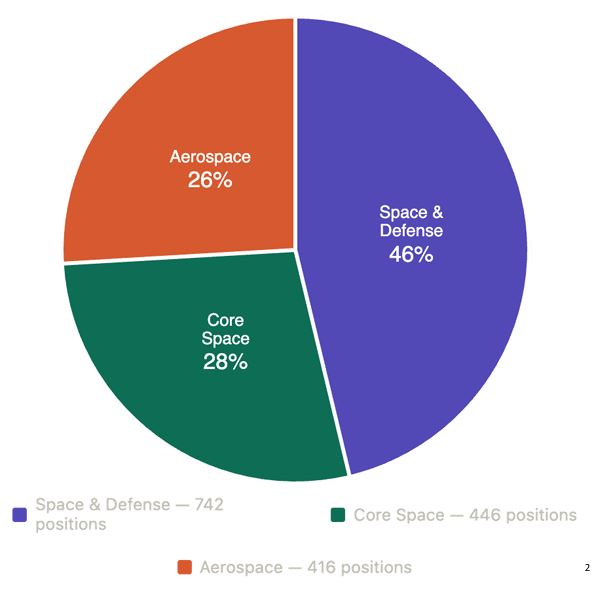
Companies in this report were classified into three primary categories: Space & Defense (companies primarily serving defense and government space customers), Core Space (companies whose primary business is civilian, scientific, or commercial space applications), and Aerospace (companies primarily serving commercial aviation and broader aerospace markets with significant crossover to space).
Space & Defense employers account for the largest share of open positions — 742 of 1,604, or 46% — despite representing only 82 of the 321 surveyed companies. This concentration reflects the dominance of large defense primes and their subcontractors, which tend to post many positions at once. Moog Space & Defense Group, Lockheed Martin, L3Harris, and KAPL alone account for 461 of those positions, or roughly 62% of the Space & Defense total.
Core Space companies are the most numerous category — 146 companies — but account for 446 positions, or 28% of the total. This category includes everything from space data startups in Manhattan to quantum computing firms in Syracuse to optics manufacturers in the Finger Lakes. The breadth of this category is a feature: it reflects the true diversity of the NY space ecosystem. However, many Core Space companies are small or early-stage and have modest current hiring needs even when their strategic role is significant.
Aerospace companies — 92 firms, 416 positions — sit between the two. This category captures the extensive network of precision manufacturers, component suppliers, testing houses, and engineering services firms that form the supply chain backbone of the NY space economy. These are often family-owned or mid-sized businesses with strong track records and stable hiring needs.
One of the most interesting findings from the data collected is the degree of employer concentration. Of 321 companies surveyed, only 130 (40%) had any active job postings at the time of the survey. The remaining 60% either had no careers page, listed no current openings, or directed applicants to submit a general resume for future consideration.
Among the 130 active employers, the distribution is highly skewed. Just 34 companies with 10 or more open positions account for 1,224 positions — 76% of the total. The top 10 employers alone represent 833 positions, or 52% of all identified jobs. Those ten companies, in order, are Moog Space & Defense Group (152), Lockheed Martin (125), GE Aviation (124), L3Harris (108), KAPL (76), Palantir (65), Raytheon Technical Services (57), Pratt & Whitney (43), Magellan Aerospace (42), and Unison Industries/GE Aerospace (41).
This concentration is not inherently problematic, but it does suggest that the health of NY's space workforce market is somewhat sensitive to the hiring decisions of a handful of major companies. A drawdown at Moog Space & Defense Group or Lockheed Martin would have an outsized regional impact, particularly in Western New York where the two firms together account for 64% of the region's open positions.
At the same time, the long tail of smaller companies represents genuine opportunity. Many of the 191 companies with no current postings are active businesses that hire intermittently or prefer direct referrals. The absence of a careers page does not mean absence of workforce need — instead it can often reflect the limited HR infrastructure of small manufacturers and engineering boutiques.
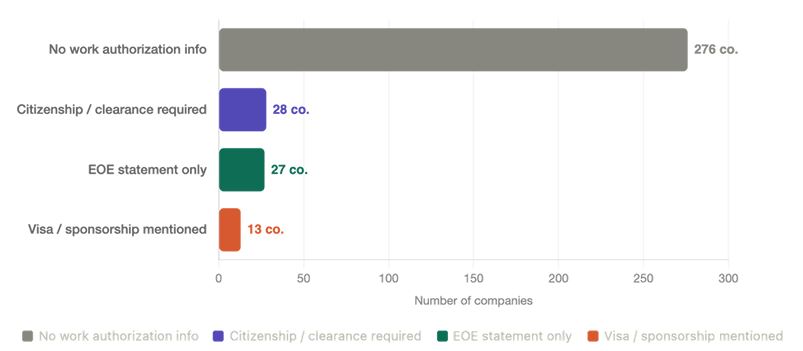
Work authorization requirements are a defining characteristic of the aerospace and defense workforce — and a meaningful constraint on who can participate in the NY space economy. This survey tracked whether each company's job postings referenced US person status requirements, ITAR compliance obligations, security clearance needs, or visa sponsorship availability.
The results reflect the dual nature of the NY space sector. On one hand, 28 companies — accounting for 662 positions — explicitly require US citizenship, US person status, or security clearance. This includes many of the largest employers: Lockheed Martin, L3Harris, Raytheon, KAPL, Northrop Grumman, and others operate under ITAR or classified contract requirements that restrict employment to US citizens or lawful permanent residents. These 676 positions are effectively unavailable to international students, recent visa holders, and a significant portion of the NYC-area workforce.
On the other hand, the majority of surveyed companies, 276, provided no substantive information on work authorization requirements. Of those, 27 companies (8.4% of all surveyed) listed only a generic Equal Opportunity Employer statement, which addresses non-discrimination but says nothing about visa eligibility or sponsorship. The remainder had no notation at all or were explicitly recorded as having no mention of work authorization in their postings.
Only 13 companies explicitly mentioned visa sponsorship availability (with most indicating they do not sponsor). This suggests that the NY space sector is, on balance, a difficult employment market for candidates who require work visa support, a consideration that is relevant to university partnership programs, international talent pipelines, and economic development initiatives targeting diverse populations.
Of the 321 companies surveyed, 120 disclosed compensation in at least one posting, meaning salary information was available for about 37 percent of employers in the sample. The pay range in this sector is broad. Based on disclosed salaries, annualized pay runs from about $34,320 at the low end — reflecting New York City's minimum wage of $16.50/hour — to roughly $265,000 at the high end. The median annual salary is about $83,200, while the average is about $93,900. This gap suggests that a smaller group of high-paying engineering, management, and business development roles pushes the average upward. The 25th percentile is about $57,500 and the 75th percentile is about $124,300, meaning the middle half of disclosed salaries falls roughly between the high-$50,000s and the mid-$120,000s.
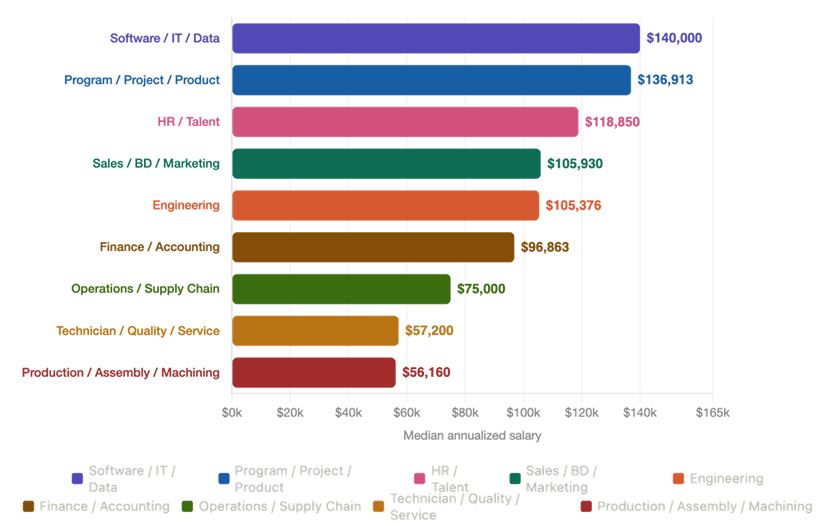
Salaries also vary clearly by function. The highest-paying roles are concentrated in software, IT, data, and program or product work, where median pay is roughly $137,000 to $140,000. Engineering also pays well, with a median of about $105,400. Other business and professional functions are somewhat lower but still solid: median pay is about $118,850 in HR, $105,930 in sales, business development, and marketing, $96,863 in finance and accounting, and $75,000 in operations and supply chain. The lowest-paying functions are production, assembly, machining, technician, quality, and service roles, where median pay is closer to $56,000 to $57,000.
Overall, the salary distribution shows demand at both the lower-paid production end and the higher-paid professional end of the labor market. About 16 percent of observed pay points fall below $50,000 a year, mostly in assembler, warehouse, inspection, and other entry-level production-support roles. At the same time, about 39 percent are at or above $100,000, and about 14 percent are above $150,000, reflecting strong demand for engineers, program managers, software and systems specialists, and senior commercial staff. About 31 percent of normalized pay observations are hourly rather than salaried, which also points to the sector’s large production and technician workforce.
Several themes emerge clearly from this first systematic look at hiring demand in New York’s space sector:
The hiring footprint is larger and more distributed than commonly recognized.
Among 321 companies surveyed, we identified 1,550 open positions across all ten official regions of the state. Hiring is not confined to the New York City metro area or a single aerospace cluster — it spans defense contractors in Bethpage and Owego, optics firms in Rochester, satellite manufacturers in Cazenovia, and space data startups in Brooklyn.
Long Island and Western NY are the primary hiring anchors — but for different reasons.
Long Island’s strength comes from depth: 120 companies, many of them small and mid-sized, create a dense supply chain ecosystem. Western NY’s strength comes from scale: a smaller number of large employers generate a concentrated share of open positions. These two regional patterns have different policy implications- Long Island benefits from stronger connections across firms, while Western NY depends more heavily on maintaining and expanding its anchor employers.
Most jobs are in-person or hybrid — fully remote roles are rare.
This sector runs on hardware, and hardware requires physical presence. Only about 30 identified positions appear to be fully remote out of 1,550 total openings. For workforce development, this means geography matters: proximity to employers is a real constraint, and transportation access to manufacturing clusters is an important equity issue.
Hiring demand is highly concentrated among a small number of companies.
Roughly 36 companies account for about 75 percent of all identified openings. This level of concentration creates risk, changes at a handful of large employers can significantly reshape the hiring landscape, but also creates opportunity. Targeted partnerships with a relatively small group of key firms could have an outsized impact on workforce pipeline development.
Work authorization requirements restrict access to a meaningful share of jobs.
At least 662 positions, about 43 percent of all identified openings, are at companies that explicitly require U.S. citizenship or clearance eligibility. This is a structural feature of the defense-adjacent space sector and has important implications for who can access these jobs and how workforce programs should be designed.
Salary data suggests a split labor market.
The salary distribution shows a clear divide between lower-paid production and technician roles and higher-paid engineering, software, and management roles. Entry-level and shop-floor roles are often clustered below $55,000, while many technical and professional roles exceed $100,000. Expanding pathways that help workers move from production roles into higher-paying technical positions may be one of the most important workforce opportunities in the sector.
Section 7: Data Gaps & Next Step
This report represents a preliminary analysis— a manually collected snapshot of hiring demand in a dynamic and complex market. It should be treated as a baseline, not a definitive census. Several important data gaps limit the conclusions that can be drawn, and addressing them should be a priority for Empire Space’s research agenda.
Historical data and trend tracking
This report captures a single moment in time in late February to early March 2026. The hiring landscape is not static: companies expand, contract, win and lose contracts, and shift hiring priorities. Without longitudinal data, it is not possible to distinguish short-term hiring spikes from long-term trends. Regular tracking, ideally quarterly, would be ideal to make this dataset more actionable.
Granular salary analysis
Salary analysis is limited by partial disclosure and inconsistent formatting across postings. Future work should break down compensation by region, work modality (in-person vs. hybrid vs. remote), job type (engineering, manufacturing, business functions), and experience level. A more detailed salary view would support benchmarking and help identify gaps in workforce investment.
Job classification and role taxonomy
The dataset includes detailed role descriptions, but they are not standardized. Each company lists roles in its own format, making systematic analysis difficult. Developing and applying a consistent taxonomy ( such as engineering, skilled trades, program management, software/data, sales/business development, and administrative for example) would enable clearer insight into occupational demand and improve
alignment with workforce training initiatives for the future.
Indirect and supply chain employment
This dataset captures direct hiring only. The sector also supports significant indirect employment through suppliers, service providers, logistics firms, and other partners. Capturing this broader footprint would be able to provide a more complete picture of the sector’s economic impact.
Total compensation beyond base salary
Posted salaries reflect base pay only. Benefits, equity, overtime, shift differentials, and union agreements can materially change total compensation, particularly for manufacturing roles. Future analysis should account for these factors where possible.
Process Improvements Required
Automation of data collection
The current dataset was built through manual research — reviewing company websites, job boards, and postings one by one. This approach is time-intensive, inconsistent, and difficult to scale. Building an automated data collection and extraction pipeline is one of the most important investments needed to support ongoing updates.
Data quality and standardization
Manual entry introduces inconsistencies in how key variables are recorded, including job counts, salary formats, location data, and work modality.
User interface and public access
The goal is to make this data accessible to job seekers, employers, policymakers, and researchers. This likely requires an interactive dashboard or map-based interface hosted on empirespace.org, updated regularly and designed for non-technical users. The current spreadsheet is a working dataset, not yet a public-facing product.
This report represents a first step toward building a more data-driven understanding of hiring demand across New York’s space and aerospace sector. By bringing together information from hundreds of companies across the state, it begins to surface the structure, constraints, and opportunities shaping the current labor market. The findings suggest that New York’s space workforce is neither small nor centralized, but a fragmented and increasingly interconnected network spanning defense manufacturing, advanced aerospace production, software, optics, research, and emerging commercial space activity.
The report also points to a central challenge facing the New York space ecosystem moving forward: not whether workforce demand exists, but whether the state’s institutions, employers, and infrastructure can coordinate effectively enough to support continued growth. These insights are essential to understanding how New York’s space economy is evolving, and what will be required to both sustain and strengthen it in the years ahead.